Children are expected to attend school every day that the school is open, unless there is a statutory reason for absence or the school has granted permission for the absence. There are two types of absence:
- Authorised absence – where the absence meets the criteria for an authorised absence or has been approved by the school
- Unauthorised absence – where the absence does not meet the criteria for authorisation or has not been approved by the school
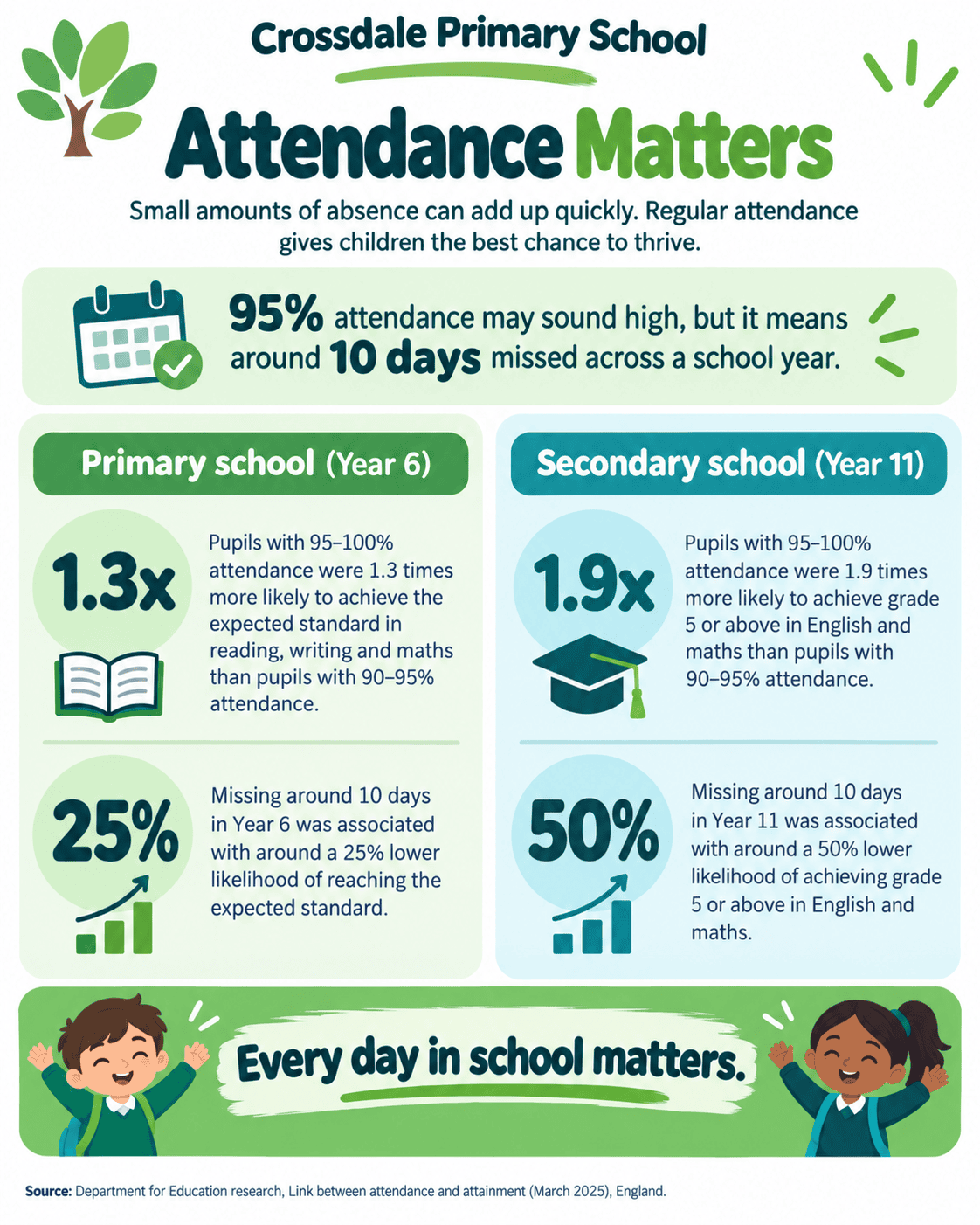
We want every child to attend school as regularly as possible. An attendance figure of 95% may sound high, but it means missing around one day of school every four weeks. Even relatively small amounts of absence can add up over time, so we monitor attendance carefully and work with families where attendance begins to cause concern:
- A caring and supportive atmosphere where children come first
- Careful registration, making sure mistakes are not made
- If a message has not been received, we will make a phone call or text home on the first morning children are absent from school
- Information for parents about attendance on a termly basis, at the end of each term
- Monitoring and support where a child’s attendance begins to cause concern. Attendance below 90% is classed nationally as persistent absence. This means a child is missing more than one day of school every two weeks on average, so we aim to work with families before attendance reaches this point, as well as providing appropriate support where absence becomes persistent.
Attendance below 90% is classed nationally as persistent absence. At this level, a child is missing more than one day of school every two weeks on average — equivalent to almost four weeks of school across a full academic year.
That is a significant amount of missed learning. Teaching builds day by day, so repeated absence can leave gaps that become increasingly difficult to catch up, affecting a child’s progress, confidence and ability to keep up with their classmates.
Please see our Attendance Policy at the bottom of this page for full details of how we promote, monitor and support attendance, and how we respond where absence becomes a concern.
Sickness and Absence
If your child has diarrhoea and/or vomiting, they should remain away from school until at least 48 hours after the last episode.
For other illnesses, whether a child needs to stay off school will depend on their symptoms and the relevant health guidance.
If you are unsure whether your child should attend school, please contact the school office by telephoning (0115) 974 8088 or by email at admin@crossdale.notts.sch.uk.
You can also check the NHS guidance, Is my child too ill for school?, and the UK Health Security Agency guidance on public health exclusion periods in children and young people’s settings, which explains when children should stay away from school because of infectious illness and when they can return.
If a child is unable to attend school for any reason, such as illness or a doctor’s appointment, it is vital to ring into school before 8.50am, giving the reason and when you expect the child to return to school. If we haven’t heard from you by 10am, we will get in touch by text or by telephone.
Holidays During Term Time
When a pupil is absent from school during term time, this can disrupt their learning and make it more difficult for them to keep up with the work being taught.
School will only authorise leave of absence during term time where there are exceptional circumstances. Each request will be considered individually by the Headteacher, taking account of the circumstances and the impact of the absence on the child’s education.
School will not authorise holidays during term time.
The following are examples of circumstances that would not normally be considered exceptional and would not usually result in leave being authorised:
- My work does not allow me to take holidays during the school holiday periods.
- The days overlap with the beginning or end of term.
- My child needs a holiday at quieter times due to their needs.
- Our holiday has been gifted or arranged by others, and we did not have a choice of dates.
- My child has good or 100% attendance.
- There is availability of cheaper holidays and travel arrangements.
- We booked the holiday before checking with the school.
- The holiday dates of siblings or family at other schools are different.
- We have day trips or birthday plans.
- It is a special sporting fixture, show or event that I want my child to attend.
Where a child has been reported as unwell but the school has reason to believe that the absence may be for another purpose, we may seek further information. This may include a home visit and/or asking parents to provide evidence of travel dates.
Where absence is unauthorised, it will count towards the national threshold for a penalty notice. Where the national threshold is met — 10 unauthorised sessions within any rolling 10 school weeks — the school will refer the matter to the Local Authority in line with the National Framework. Parents will be informed where unauthorised absence may lead to a penalty notice or other legal intervention.
Requesting Pupil Absence in Term Time
If you believe there are exceptional circumstances which mean your child needs to be absent during term time, please complete our Leave of Absence Request Form as far in advance as possible and, wherever possible, at least four weeks before the proposed absence.
Submitting a request does not mean that the absence has been authorised. Your child should continue to attend school unless and until you have received confirmation from the school that leave has been granted.
Lateness
School starts at 9.00am and children should be in school by this time. When children arrive late, they miss important learning and routines at the start of the day. Arriving late can also be unsettling for the child and disruptive for the rest of the class.
- Children arriving between 9.10am and 9.30am will receive a late mark (L).
- Children arriving after 9.30am will be recorded as an unauthorised absence (U) for the morning session.
- Any child arriving after the school gate has closed should be brought to the school office and signed in.
Where lateness becomes a concern, we will contact parents and work with families to understand any barriers and improve punctuality.
If a child is late 10 minutes each day it equates to 7 lost teaching days across the year. 20 minutes late each day equates 70 missed lessons across the year.
Please pop into school if you would like to discuss your child’s attendance.
If a child is late 10 minutes each day it equates to 7 lost teaching days across the year.
20 minutes late each day equates 70 missed lessons across the year.
Please pop into school if you would like to discuss your child’s attendance.
Attendance matters now — and later
Recent Department for Education research shows a clear relationship between attendance and attainment.
At primary school, Year 6 pupils with 95–100% attendance were 1.3 times more likely to achieve the expected standard in reading, writing and maths than pupils attending 90–95% of the time. Missing around 10 days in Year 6 was associated with around a 25% reduction in the likelihood of reaching the expected standard.
The impact continues into secondary school. Year 11 pupils with 95–100% attendance were 1.9 times more likely to achieve grade 5 or above in both English and maths than pupils attending 90–95% of the time. Missing around 10 days in Year 11 was associated with around a 50% reduction in the likelihood of achieving this outcome.
Every day in school matters. Small amounts of absence can add up quickly.